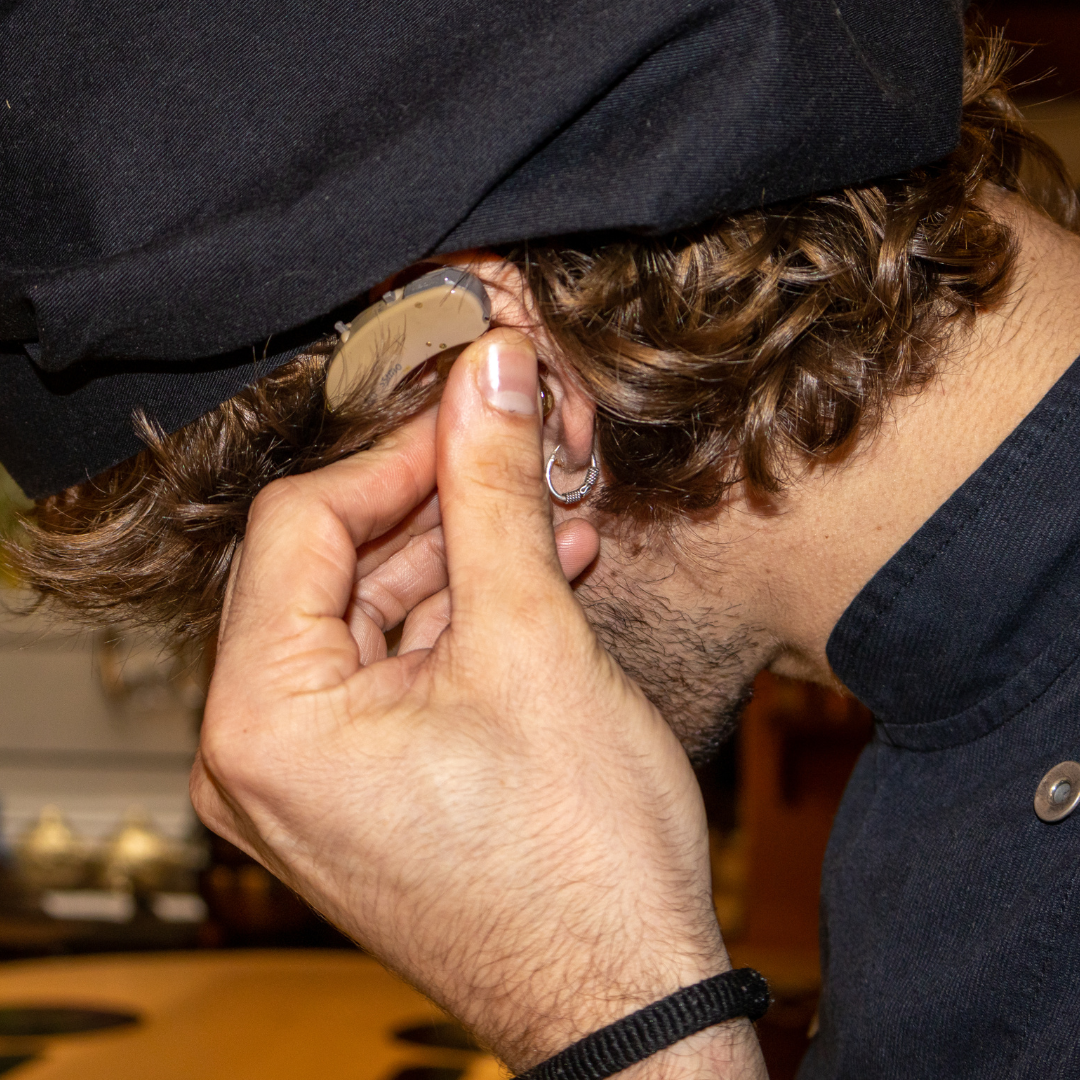
Group discussions in restaurants often become difficult to comprehend when room acoustics compete with your focus and hearing. We perform comprehensive diagnostic assessments to evaluate hearing in quiet rooms and challenging acoustic spaces to identify functional deficits. When we isolate the root mechanism behind your difficult hearing, we guide you toward customized communication solutions.
Why Do I Hear Well in Quiet but Struggle in Restaurants?
Low-noise environments yield an advantageous signal-to-noise ratio where primary speech remains significantly louder than background sound. Modern restaurant environments create the complete opposite listening environment. Background voices, loud music, service clatter, and wall reflections collide with spoken words, demanding heightened cognitive processing to isolate individual speech.
This symptom pattern often reflects underlying high-frequency hearing loss, central processing dysfunction, or physiological aging of the auditory nerve. Dim lighting, physical tiredness, conversational distance, and divided attention exacerbate these listening deficits. Numerous individuals show standard hearing thresholds on paper but reveal marked comprehension drops on clinical speech-in-noise testing. Consistent difficulty following restaurant conversation warrants clinical investigation even when everyday hearing seems largely unaffected.
Clinical Evaluation of High-Frequency Hearing Loss
We begin by reviewing your history of communication difficulties, prior noise exposures, ringing or tinnitus, pharmaceuticals, and unilateral symptoms.
Clinical pure-tone audiometry identifies hearing threshold levels across various frequencies by delivering sounds through air and bone pathways. High-frequency hearing loss commonly presents on the audiogram as a characteristic precipitous drop in the higher frequency ranges. Further clinical diagnostics feature tympanometry to evaluate eardrum and middle-ear mechanics as well as word-recognition testing for speech comprehension.
A quiet sound booth cannot replicate complex dining room acoustics, which makes clinical speech-in-noise testing especially informative. It calculates your ability to identify verbal phrases as competing background noise levels rise. Together, these audiological findings indicate whether the issue involves sound audibility, speech intelligibility, noise-processing dysfunction, or multiple compounding factors.
The Role of Central Auditory Processing Disorders in Adults
An auditory processing disorder affects how the central auditory nervous system interprets sound. Even when the ears detect individual frequencies accurately, the central auditory system may falter at sorting overlapping voices, distinguishing close speech sounds, or processing fast-paced dialogue. We systematically verify peripheral hearing health before establishing whether an advanced auditory-processing evaluation or medical referral serves your needs.
Actionable Listening Tips for Noisy Social Settings
Targeted behavioral changes optimize the acoustic speech signal reaching your auditory system while providing clear visual context. Prior to dining, choose venues known for lower noise levels or schedule meals during quieter dining hours. Establishments designed with high-walled booths, acoustic wall treatments, heavy fabrics, and carpeting reduce reverberation far better than modern industrial spaces with bare surfaces.
Upon entering the restaurant:
- Request a table away from the kitchen, bar, speakers, and large groups.
- Position yourself with your back toward a solid partition to dampen intrusive background noise from behind.
- Face your conversation partners in good lighting.
- Minimize the physical gap separating you and the person speaking as much as reasonably possible.
- Angle your stronger-hearing ear toward the primary individual you wish to converse with.
- Ask speakers to reword the specific phrase you missed rather than repeating their initial wording.
- Validate significant pieces of information directly rather than feigning understanding during dialogue.
- Step away for a brief auditory rest when cognitive listening fatigue begins to set in.
- Ask companions to speak clearly at a natural pace.
- Raised or shouting voices warp acoustic phonetics and rarely improve speech intelligibility.
Assistive Listening Technologies for Noisy Environments
The best technology depends on the cause of the difficulty, the listening environment, and whether hearing loss is present. Customized hearing aids employ directional microphone beamforming, noise cancellation algorithms, and targeted dining programs to prioritize speakers in front while lowering ambient noise. Realistic expectations are vital, since even advanced hearing devices cannot completely erase background conversational chatter.
Pairing your devices with a remote wireless microphone generates a substantial improvement in the direct signal-to-noise ratio. Worn on the speaker’s collar or set on the table, the microphone broadcasts direct audio to paired hearing aids or specialized receivers. This reduces the effects of distance and surrounding noise.
Further practical hearing technology options include:
- Wireless conference table microphones that capture multi-speaker discussions
- Telecoil sensors configured to access hearing-loop broadcasts in looped facilities
- Smartphone live-captioning platforms providing instant speech-to-text visual support
- Smart earbuds offering dedicated speech-in-noise amplification settings
- Sound-level or restaurant-review tools for finding quieter locations
We evaluate these technological options, ensure full hardware compatibility, and instruct you on maximizing your selected system.
Professional Audiological Solutions for Loud Listening Environments
A professional clinical assessment moves beyond basic baseline statements like “I hear fine in quiet rooms.” We can review the places, speakers, and noise levels that cause problems and select tests that reflect those concerns. The diagnostic battery may encompass pure-tone thresholds, acoustic middle-ear evaluations, suprathreshold word recognition, and speech-in-noise measures. Diagnostic auditory-processing testing may be recommended if your clinical symptoms and baseline evaluations suggest central auditory dysfunction.
Abrupt auditory reductions, unilateral hearing shifts, or rapid functional deterioration require prompt assessment by an ear, nose, and throat physician. Personalized patient care establishes the true medical source of your listening problems instead of assuming ambient noise is solely responsible.
Contact Us for a Hearing Evaluation Today
If struggling through dinner conversation leaves you mentally exhausted, detached, or constantly guessing, schedule a complete hearing evaluation with our clinic. Our clinical team will determine the best strategies to improve your hearing in noisy environments through custom hearing-aid programming, remote microphones, or targeted auditory rehabilitation.
Contact us to request an appointment and take the next step toward easier conversations.
